
Every material has a boundary. The honest ones know where theirs is.
Flax fiber composites deserve the excitement they are getting. Lighter than carbon, dramatically cleaner to produce, and genuinely superb at damping vibration. But excitement is not engineering, and every material has a boundary beyond which it stops being the answer. Here is the honest map of where flax’s territory ends and carbon fiber’s begins, because knowing the boundary is what makes the good news trustworthy.
The Strength Gap Is Not Close
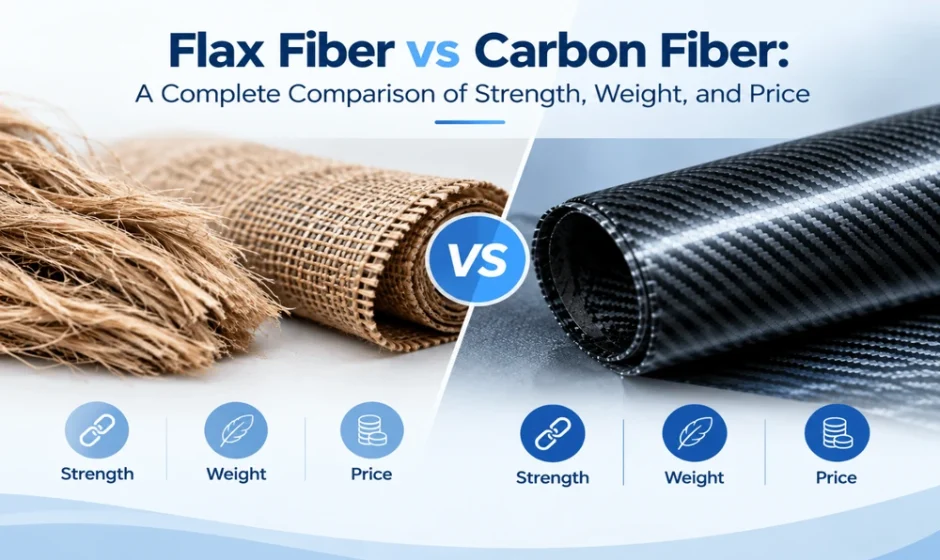
Start with the number that settles most arguments: tensile strength. Carbon fiber laminates deliver roughly 3,000 to 7,000 MPa. Flax delivers 500 to 1,500. Respectable for a natural fiber, but a fraction of carbon’s capability. Stiffness is similar: carbon’s modulus runs 230 to 640 GPa against flax’s 30 to 70. For any part whose job is carrying serious load, structure, suspension, safety cells, the flax vs carbon fiber comparison is not a competition. It is a boundary marker.
The Heat Boundary
Carbon fiber’s fibers shrug at temperatures that would destroy most materials; even the resin systems around them handle 120 to 200 degrees Celsius in automotive grades. Flax is a plant. Cellulose fibers degrade at sustained temperatures that automotive under-hood and exhaust-adjacent zones see regularly, and its resin systems face the same ceiling with less margin beneath it. Brake ducts, engine covers near turbos, exhaust shrouds. These are metal and carbon jobs. Flax need not apply.
The Moisture Question, Honestly
Plant fibers drink. Cellulose is hydrophilic, and flax fibers absorb atmospheric moisture, swelling slightly and stressing the fiber-resin bond over time. Modern treatments, fiber surface chemistry, sealed resin systems, careful edge sealing, manage this well enough for race cars and production interiors. But ‘managed’ is not ‘eliminated,’ and it means flax parts carry a manufacturing-quality dependency that carbon largely does not. Buy flax from operations that understand moisture management, or buy something else. This is the material’s version of carbon’s UV-and-clear-coat dependency: solvable, but only by people who respect it.
The Consistency Challenge
Carbon fiber is a manufactured product: every filament comes off the line within tight tolerances, batch after batch, year after year. Flax is an agricultural product. Fiber properties vary with the growing season, the field, the weather, the processing. Suppliers work hard to normalize this, and the best achieve impressive consistency. But it is a consistency that must be earned continuously, not one the process guarantees. For appearance parts this barely matters. For parts where load paths are calculated to the decimal, it matters enormously.
The Track Record Gap
One more honest asymmetry: time. Carbon fiber has forty years of automotive service data. Crash histories, aging curves, failure modes documented across millions of parts. Flax has a decade of serious motorsport and production use. That is not nothing, but it is not parity. Long-term behavior questions, twenty-year UV exposure, a hundred thousand thermal cycles, a lifetime of car washes, are answered for carbon and still being answered for flax. Early adopters of any material accept this trade knowingly; everyone else should simply know it exists.
The Service Network Gap
One limit hides downstream of the material itself: the people. Carbon fiber has a forty-year ecosystem of repair shops, composite specialists, and accumulated folklore. Damage assessment, repair techniques, refinishing protocols all exist at scale. Flax composite repair is newer territory, handled confidently by fewer hands. For an interior trim piece this is irrelevant. For a structural-adjacent part you plan to keep for a decade, the question ‘who can fix this near me’ is part of the purchase. Materials live in ecosystems, and ecosystems take time to grow.
The Zones Where Carbon Remains King
- Chassis and survival structure: the strength gap is an order of magnitude. No debate.
- Suspension and driveline components: fatigue loads and precision rule.
- High-heat zones: under-hood, exhaust-adjacent, brake-adjacent.
- Aero under serious load: wings making real downforce need real stiffness.
- Wheels and rotating parts: the highest-stress application on the car, carbon’s hardest-won territory.
And Where the Boundary Opens
The honest map has another side. Interior panels, seat shells, door cards, headliners, trim, the parts that need moderate strength, love damping, and never see real heat, are flax’s legitimate territory, expanding as supply chains mature. Exterior bodywork on road cars sits at the frontier. The carbon fiber material guide defines what the structural side demands; everything not on that list is a conversation flax has earned a seat in.
Materials earn trust by having their limits stated clearly, not hidden. Flax’s limits are real: strength, heat, moisture, consistency. Its gifts are equally real: weight, damping, footprint. The builds that get this right will use each material inside its territory. And the territory lines, not the hype, are what make both materials worth specifying. Buy within the boundaries, maintain what you buy, and both materials will still be doing their jobs long after the hype has moved on.