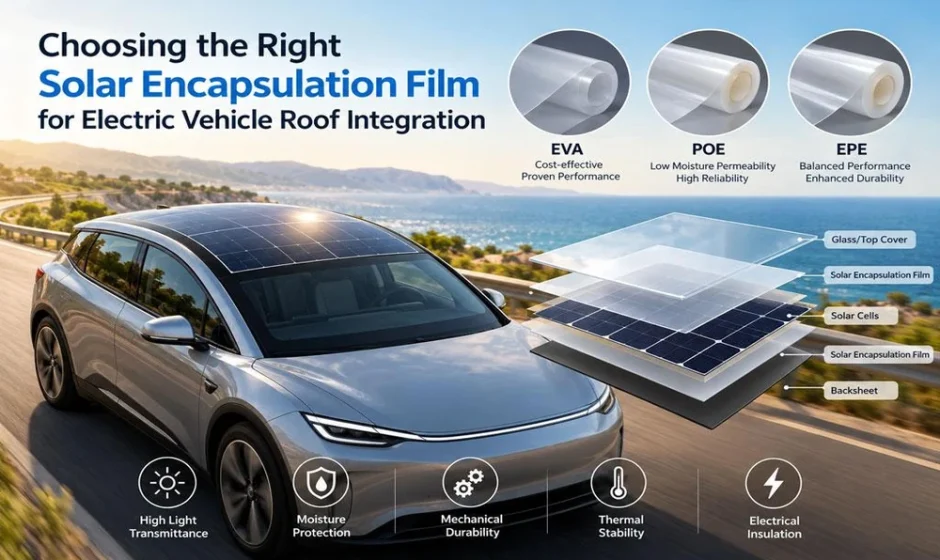

As electric vehicles (EVs) continue to evolve, automotive manufacturers are exploring innovative ways to improve energy efficiency, extend driving range, and reduce dependence on external charging. One promising technology is vehicle-integrated photovoltaics (VIPV), which incorporates solar cells directly into vehicle surfaces, particularly roofs.
However, integrating photovoltaic modules into electric vehicle roofs presents challenges beyond those encountered in conventional solar installations. Curved surfaces, vibration, temperature fluctuations, limited installation space, and strict automotive safety requirements all influence material selection.
Among the essential components, PV encapsulation film plays a critical role in protecting photovoltaic cells, maintaining optical performance, and ensuring long-term reliability.
This article explores how to choose between EVA, POE, and EPE solar encapsulation films for electric vehicle roof applications.
Why Solar Encapsulation Films Matter in Electric Vehicle Roofs
Solar encapsulation films are polymer-based materials positioned around photovoltaic cells within a laminated solar module. They bond the module layers together while protecting sensitive electrical components from environmental and mechanical damage.
For electric vehicle roof integration, encapsulation films must provide several essential functions:
- High light transmittance: Maximize sunlight reaching photovoltaic cells to support energy generation.
- Moisture protection: Reduce water vapor penetration that can accelerate corrosion and electrical degradation.
- Mechanical protection: Help absorb stress caused by vibration, thermal expansion, and vehicle movement.
- Thermal stability: Maintain performance under elevated roof temperatures and repeated temperature cycling.
- Electrical insulation: Reduce leakage-current risks and support reliable module operation.
Unlike stationary rooftop solar panels, vehicle-integrated modules experience continuous movement and more complex mechanical loading. Consequently, encapsulation materials must be evaluated as part of the complete automotive photovoltaic system.
EVA vs. POE vs. EPE: Understanding the Differences
Three common encapsulation material options are ethylene-vinyl acetate (EVA), polyolefin elastomer (POE), and co-extruded EPE films.
Each offers different advantages depending on photovoltaic cell technology, module structure, and operating conditions.
1. EVA Solar Encapsulation Film
EVA solar encapsulation film is widely used in photovoltaic module manufacturing because of its established processing characteristics, optical transparency, and cost efficiency.
Its advantages include:
- High optical transparency for efficient sunlight transmission.
- Good adhesion to compatible glass and module materials.
- Established lamination processes and manufacturing experience.
- Competitive material costs for large-scale production.
For electric vehicle roof applications, EVA may be suitable for cost-sensitive designs where moisture management and electrical reliability have been adequately validated.
However, some EVA formulations can generate acetic acid during aging, potentially contributing to corrosion when moisture is present. Formulation selection and accelerated aging tests are therefore important.
2. POE Solar Encapsulation Film
POE solar encapsulation film is increasingly considered for advanced photovoltaic modules requiring improved moisture resistance and electrical insulation.
Compared with conventional EVA formulations, POE generally offers lower water vapor permeability and favorable electrical resistivity.
Its advantages include:
- Low moisture permeability for enhanced environmental protection.
- Strong electrical insulation characteristics.
- Reduced risk of acid-related corrosion associated with EVA degradation.
- Potential compatibility with moisture-sensitive and advanced solar cell technologies.
For electric vehicle roofs exposed to humidity, temperature cycling, and demanding outdoor conditions, POE can be an attractive encapsulation solution.
However, manufacturers must carefully control lamination parameters and verify adhesion to the selected substrates.
3. EPE Co-Extruded Solar Encapsulation Film
EPE solar encapsulation film combines EVA outer layers with a POE core through a co-extrusion process.
This multilayer structure aims to combine EVA’s adhesion and processing advantages with the moisture-resistance and electrical properties of POE.
Potential benefits include:
- Balanced adhesion and moisture protection.
- Compatibility with established photovoltaic lamination processes.
- Improved electrical insulation compared with some conventional EVA solutions.
- A potential balance between performance and manufacturing cost.
EPE may be particularly useful for automotive photovoltaic designs requiring both reliable bonding and improved environmental durability.
However, actual performance depends on layer thickness, formulation, interfaces, and module construction.
Key Factors When Selecting Encapsulation Films for EV Roofs
Optical Performance and Energy Efficiency
Vehicle roof surfaces provide limited photovoltaic installation area. Therefore, maximizing light transmission is particularly important.
Manufacturers should evaluate film transmittance, haze, ultraviolet stability, and long-term optical aging.
Temperature Resistance and Thermal Cycling
Electric vehicle roofs experience substantial temperature variations during outdoor operation.
Encapsulation materials must maintain adhesion, dimensional stability, and electrical insulation throughout repeated heating and cooling cycles.
Thermal cycling tests should assess cracking, delamination, and changes in material properties.
Flexibility and Mechanical Durability
Automotive solar roofs may incorporate curved glass or lightweight composite structures.
Encapsulation films must accommodate the geometry and thermal expansion of different module materials without introducing excessive stress.
Vibration, bending, and mechanical fatigue testing are especially important for nontraditional roof constructions.
Moisture Resistance and Long-Term Reliability
Moisture penetration can contribute to corrosion, insulation degradation, and photovoltaic performance loss.
POE and EPE may offer advantages where low moisture permeability is a priority.
Nevertheless, overall moisture protection also depends on edge sealing, module construction, and manufacturing quality.
Comparison of EVA, POE, and EPE for Electric Vehicle Roofs
| Selection Criteria | EVA | POE | EPE |
|---|---|---|---|
| Optical transparency | High | High | High |
| Moisture resistance | Moderate | Generally high | Formulation-dependent |
| Electrical insulation | Good | Generally excellent | Generally strong |
| Processing maturity | Very high | Established | Established |
| Adhesion characteristics | Generally strong | Formulation-dependent | Designed for balanced adhesion |
| Relative material cost | Lower | Higher | Intermediate, typically |
| Potential application | Cost-sensitive designs | High-reliability designs | Balanced-performance designs |
How to Make the Right Choice
There is no universally superior encapsulation film for every electric vehicle solar roof.
EVA is worth considering when established processing, optical performance, and cost efficiency are primary requirements.
POE is attractive when moisture resistance, electrical insulation, and long-term reliability are especially important.
EPE provides another option for manufacturers seeking a balance between adhesion, processing compatibility, and protective performance.
Before mass production, automotive and photovoltaic manufacturers should validate candidate films through optical measurements, damp-heat exposure, thermal cycling, mechanical testing, electrical insulation evaluation, and adhesion testing.
Relevant photovoltaic qualification standards, including IEC 61215 and IEC 61730, can inform testing, but vehicle-specific mechanical, environmental, and safety requirements must also be addressed.